
The Mystery of the Floating Wheels: How Truck Lift Axles Save Money and Roads
The Mystery of the Floating Wheels: How Truck Lift Axles Save Money and Roads
Introduction
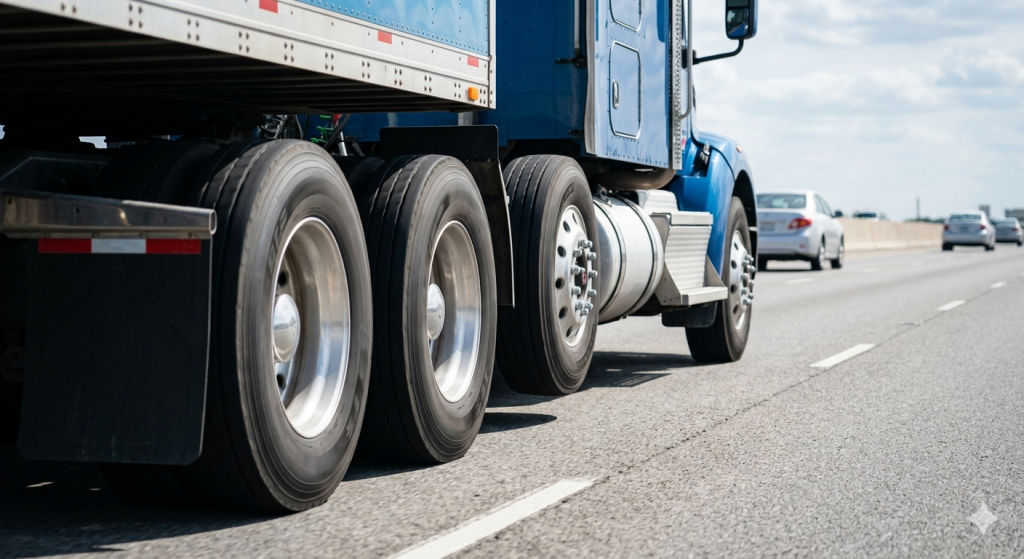
Have you ever really looked at a huge container truck or a cement mixer lorry passing by on the road?
Sometimes, you might have noticed that a whole row of wheels on these giant vehicles isn’t even touching the ground—they’re lifted above the road. At first glance, people often think this must be some kind of fault in the vehicle.
But those raised wheels are not a defect at all. In fact, they help save billions of rupees annually in road repair costs, reduce a large amount of diesel consumption for truck owners, and even prevent the truck from breaking apart when taking turns. Sounds hard to believe, right? Let’s talk about the physics and engineering behind these “floating wheels” (lift axles)! 🛠️🛣️
To understand these floating wheels, we first need to understand the road beneath them. No matter how strong concrete or asphalt roads are, they have a maximum load they can تحمل. If too much weight is applied to one spot, the road will break apart.
Imagine you’re walking on deep snow. If you wear high heels, you’ll sink immediately. But if you wear wide snowshoes, your weight is spread over a larger area (weight distribution), so you can walk smoothly on top of the snow.
The extra row of wheels on trucks is called a “lift axle.” These work just like snowshoes! When a truck carries around 20 tons of sand or gravel, that load is too much for just two axles. If all that weight is concentrated, it damages the road. So, when the driver presses a switch in the cabin, the raised wheels come down and share the load. Now the weight is distributed across more wheels, preventing road damage and allowing the truck to comply with legal axle weight limits without fines.
Now you might wonder: if spreading the load is good, why lift the wheels at all? Why not keep them on the ground all the time?
The answer is simple: money! 💸⛽
Truck tires are very expensive. When wheels roll on the road, friction wears them down and requires more engine power, which increases fuel consumption.
Imagine the truck has unloaded its cargo and is returning empty. There’s no heavy load anymore. If all those extra wheels stay on the ground, they just waste fuel and wear out unnecessarily. So the driver lifts them back up. It’s like an “Eco Mode” for a giant vehicle! This can save hundreds of liters of diesel per year.
In countries like the United States and Europe, highway and bridge tolls are often based on the number of axles touching the ground. More wheels on the road means higher toll fees.
So when the truck is empty, drivers lift the lift axle. Then at the toll gate, the system sees fewer axles—like a smaller vehicle—so they pay much less. For trucks passing multiple tolls daily, this leads to significant monthly savings. 🛣️💰
One of the most important functions of these lift axles is during turning. Large trucks are very long vehicles. What happens if a long truck with 10 or 12 wheels on the ground tries to take a sharp turn?
Even if the front wheels turn, the rear wheels cannot follow the exact same path. So they get dragged sideways (called “scrubbing”). This creates loud noise, wears down the tires, and damages the road. Even worse, the stress on the truck’s frame and suspension can become so high that it could potentially cause structural failure. Vehicles with many wheels on the ground tend to resist turning and prefer to move straight.
The perfect solution is the lift axle. When approaching a turn, the driver lifts the extra axle. This reduces the wheelbase (distance between contact points), making the truck behave more like a shorter vehicle. It can then turn more easily without damaging tires or roads.
In the past, drivers manually controlled this using a switch. But modern trucks now use fully automatic lift axle systems. 🤖📡
These trucks have pressure sensors in the suspension. When cargo is loaded and weight increases, the system automatically lowers the extra wheels. Once the load is removed, the wheels lift again automatically. This prevents human error and protects the roads.
In some cement mixers, lift axles serve an additional purpose. When the truck is empty, the wheels are lifted to save fuel. But when filled with liquid cement, the shifting weight inside the rotating drum can destabilize the vehicle. To maintain balance and prevent tipping, the lift axles are lowered during operation.
Stay safe, stay smart, and design with confidence.